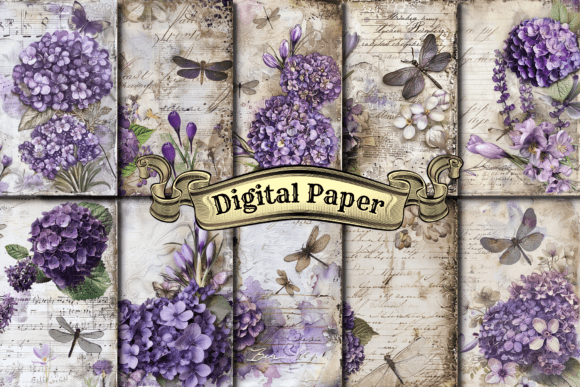
Unlocking Creativity with the Purple Hydrangea Junk Journal Digital Paper Set
The world of digital crafting has expanded rapidly, offering artists and entrepreneurs a vast array of resources to bring their visions to life. Among the many options available, the Purple Hydrangea Junk Journal digital paper set stands out as a versatile tool for those seeking high-quality, nature-inspired textures. This collection is not merely a bundle of images; it represents a foundational element for creators who want to blend organic aesthetics with modern design techniques. For adults aged 20 to 50 who are evaluating digital assets for print-on-demand businesses, personal scrapbooking, or graphic design projects, understanding the specific utility of this set is crucial before making a purchase.
At its core, a junk journal is a mixed-media art form that embraces imperfection, layering, and repurposing. Traditionally, these journals involve physical papers, fabrics, and ephemera glued onto pages. However, the digital evolution of this craft allows users to create virtual versions or prepare physical prints with precision. The Purple Hydrangea Junk Journal product addresses this need by providing ten distinct patterns in JPG and PNG formats. Each pattern measures 4000 x 4000 pixels, a resolution that ensures crisp output whether the image is used on a smartphone screen or printed on a large canvas. This level of detail is essential for anyone looking to maintain professional quality across different mediums.
Evaluating Versatility Across Creative Categories
One of the primary factors when comparing digital paper sets is their adaptability. Many products are designed for a single use case, such as website backgrounds or simple coloring pages. In contrast, the Purple Hydrangea Junk Journal collection is engineered for broad application. The inclusion of both JPG and PNG files is a significant advantage. While JPGs are standard for web use and general printing due to their smaller file size, PNGs offer transparency support. This dual-format approach allows users to layer hydrangea patterns over other designs without creating unsightly white boxes, a common frustration in digital collage work.
For entrepreneurs exploring Print on Demand (POD) services, the potential applications are extensive. T-shirts, phone cases, and homeware items often require high-resolution vector-like imagery to avoid pixelation during the printing process. A 4000 x 4000 px image provides ample room for scaling up to large formats without losing the delicate details of the purple hydrangea petals. Unlike lower-resolution clipart that might look blurry when stretched, this set maintains integrity, making it a reliable choice for commercial products where customer satisfaction depends on print quality.
Comparing Digital Assets for Crafters and Designers
When researchers compare this set against other digital resources, several distinctions emerge. Some alternatives focus heavily on solid colors or geometric shapes, which may suit a minimalist aesthetic but lack the organic depth found in floral collections. Others might offer intricate line art suitable for adult coloring books but lack the full-color texture needed for background design. The Purple Hydrangea Junk Journal occupies a unique middle ground, offering rich color palettes and naturalistic patterns that bridge the gap between decorative art and functional design elements.
In the realm of software like Silhouette Studio or Cricut Design Space, the distinction between raster (pixel-based) and vector (path-based) graphics is critical. While this set consists of raster images, the high resolution makes them highly effective for cutting machines when used as backgrounds or for "print and cut" projects. Users can place the paper behind text or shapes to create textured cards, stickers, or labels. Competing low-cost bundles often provide images at 72 DPI, which are adequate for screens but disastrous for printing. The 4000 px dimension of this set suggests a much higher effective DPI, ensuring that physical outputs feel premium rather than amateurish.
Strategic Use Cases for Different Audiences
The decision to invest in a specific digital asset often depends on the user's current project goals. For graphic designers working on branding or social media campaigns, the Purple Hydrangea Junk Journal offers an immediate way to inject personality into corporate identities or lifestyle blogs. The purple hue, associated with creativity and wisdom, can be particularly effective for brands targeting wellness, arts, or feminine-focused markets. Using these patterns for shop banners or digital backgrounds adds a cohesive visual theme that stock photos often fail to achieve.
Similarly, stationery enthusiasts planning to create notebooks, planners, or custom covers will find value in the variety of the ten included patterns. A junk journal typically relies on a mix of textures to prevent visual fatigue. Having access to ten variations of the same floral motif allows a creator to build a harmonious yet dynamic layout. This is superior to using random, mismatched papers found online, which can result in a cluttered appearance. The consistency of the source material ensures that even when layered with other elements, the final product retains a unified artistic direction.
Weighing Benefits Against Limitations
No digital product is without its tradeoffs, and a balanced evaluation requires acknowledging where this set might fall short compared to other options. The most notable limitation is that these are raster images, not vectors. If a user needs to resize a logo or an icon to an infinite scale without any loss of quality, they would need a vector format (like SVG or EPS). However, for the intended purpose of wallpaper, fabric printing, and mixed-media collages, the resolution provided is more than sufficient. The tradeoff here is file size versus flexibility; while these files are larger than basic icons, they carry the necessary data for high-fidelity reproduction.
Another consideration is the specificity of the theme. For a designer working on a tech startup or a construction company, the floral nature of the Purple Hydrangea Junk Journal may be entirely inappropriate. In such cases, abstract or industrial-themed digital papers would be a better fit. The strength of this set lies in its niche appeal. It excels in contexts where softness, nature, and vintage charm are desired. Attempting to force these patterns into a rigid, corporate environment would likely yield poor results. Therefore, the "best-fit" situation is clearly defined: projects requiring organic beauty and a handcrafted feel.
Making an Informed Decision on Digital Resources
Choosing the right digital paper set involves looking beyond the price tag and considering the long-term utility of the assets. When comparing the Purple Hydrangea Junk Journal to generic free downloads, the difference in quality and licensing becomes apparent. Free resources often come with watermarks, inconsistent resolutions, or restrictive usage rights that hinder commercial ventures. This set, with its clear specifications and high resolution, removes those barriers, allowing for confident use in POD businesses and client work.
Furthermore, the ability to use these patterns for both physical and digital outputs maximizes the return on investment. A single purchase can fuel a line of printable wall art, a collection of phone cases, and a series of social media posts simultaneously. This multi-purpose capability is rare among specialized digital goods. For the creative professional or the hobbyist looking to upgrade their toolkit, this efficiency is a deciding factor. It reduces the need to search for multiple disparate assets, streamlining the workflow from concept to completion.
Ultimately, the choice to use the Purple Hydrangea Junk Journal digital paper set depends on the alignment between the product's attributes and the creator's vision. If the goal is to produce high-quality, nature-inspired designs for a wide range of applications, this set offers a robust foundation. It provides the necessary resolution for printing, the versatility for digital editing, and the aesthetic appeal to engage an audience. By understanding these strengths and recognizing the specific scenarios where they apply, users can make a strategic decision that enhances their creative output without unnecessary experimentation or wasted resources.